Research Article
Synergistic ARC–ABD Mechanisms and Practical Pathways for Green High-Yield Agriculture within an Agroecological Simplified System 

 Author Correspondence author
Biological Evidence, 2026, Vol. 16, No. 6
Received: 12 Oct., 2026 Accepted: 25 Oct., 2026 Published: 15 Nov., 2026
Long-term reliance on chemical fertilizers and pesticides has created structural trade-offs between crop productivity, environmental degradation, and resistance risks in modern agriculture. Achieving sustainable yield improvement while reducing external chemical inputs remains a central challenge for agricultural systems worldwide. Within the framework of the Agroecological Simplified System (AESS), this study systematically investigates the synergistic mechanisms and practical pathways of Agroecological Rhizospheric Coupling (ARC) and Agro-Biological Defense (ABD). Our analysis demonstrates that ARC enhances crop growth and physiological resilience by restructuring rhizosphere microbial networks, strengthening nutrient self-cycling, and stabilizing plant metabolic states, thereby providing an endogenous foundation for both productivity and immune responsiveness. In parallel, ABD integrates multiple defense modules-including Bacillus thuringiensis (Bt), RNA interference (RNAi), biocontrol microorganisms, and natural enemy networks-to maintain pest and pathogen pressures within ecologically manageable thresholds. Rather than acting independently, ARC and ABD form a directional positive feedback loop mediated by rhizosphere health, physiological homeostasis, immune priming, and ecological regulation. ARC significantly increases crop responsiveness to defense inputs, while ABD reduces chemical disturbance and pest pressure, indirectly facilitating the establishment and persistence of beneficial rhizosphere microbiomes. Field evidence from tropical areca plantations in Hainan and rice-based systems in Zhejiang confirms that ARC-ABD integration can simultaneously stabilize or increase yields, improve soil physicochemical and microbial properties, and suppress pest and disease incidence under reduced fertilizer and pesticide inputs. Building on these findings, we propose an integrated ARC + ABD + smart agriculture framework and outline scalable implementation pathways through tiered deployment strategies, AI-assisted microbial consortium design, localized defense resource innovation, and digital management platforms. We conclude that ARC-ABD synergy represents not merely a combination of biological technologies but a paradigm shift from chemically driven agriculture toward life-process-centered system regulation. This integrated approach provides a scalable and resilient pathway for achieving green high-yield agriculture under increasing resource constraints and climatic uncertainty.
0 Introduction
Over nearly a century of rapid expansion and intensification in global agriculture, chemical fertilizers and pesticides have gradually become some of the most important and trusted inputs in agricultural systems worldwide. Whether used to maximize yield per unit area, rapidly suppress pests and diseases, or respond to market fluctuations and climatic uncertainty, chemical inputs have been viewed as an efficient, direct solution that can readily be replicated at scale. However, extensive research has shown that this production approach, which relies heavily on chemical inputs, generates short-term yield gains while also imposing mounting ecological and health costs. These include soil structural degradation and compaction, declining microbial diversity, contamination of water bodies and non-target habitats, and potential risks to human health through residues in agricultural products and occupational exposure (Chaudhary et al., 2023; Rhioui et al., 2023; Mulugeta et al., 2024).
These concerns have prompted a reassessment of agricultural policy and governance worldwide. Agricultural transition initiatives, exemplified by the European Union’s Farm to Fork Strategy, have explicitly set a target of reducing the use of hazardous chemical pesticides by 50% by 2030, seeking to guide agricultural systems toward lower chemical dependence and greater ecological resilience (Rhioui et al., 2023; Mulugeta et al., 2024). In practice, however, this transition faces substantial obstacles: for most farmers, chemical inputs remain the option perceived as carrying the lowest risk and offering the greatest predictability, whereas uncertainties persist regarding the reliability of biological or ecological alternatives, the technical support available for them, and perceptions of their risks and benefits (Rhioui et al., 2023; Mulugeta et al., 2024; Mac Clay et al., 2025). A central and urgent challenge for agricultural science and technological innovation is therefore to systematically enhance the ability of crops to withstand biotic and abiotic stresses while maintaining or even improving crop productivity and gradually reducing structural dependence on chemical inputs.
Against this background, a growing body of research has refocused on the biological foundations of agricultural systems, seeking new avenues by examining multilayered networks of interactions among crops, microorganisms, and the environment. Two technological approaches centered on biological processes have attracted increasing attention in recent years: growth-promoting strategies based on rhizosphere microbial consortia and biological defense strategies based on crop ecological immunity. On this basis, these approaches have come to be described in relevant studies as two representative systems: Agroecological Rhizospheric Coupling (ARC) and Agro-Biological Defense (ABD) (Chaudhary et al., 2023; Ku et al., 2024; Liu et al., 2024; Boyno et al., 2025).
ARC focuses primarily on activating and restructuring rhizosphere microbial networks. By integrating plant growth-promoting bacteria (PGPB), arbuscular mycorrhizal fungi (AMF), and other functional rhizosphere microorganisms or synthetic microbial communities, it improves the efficiency of nutrient transformation and uptake, promotes root development, and optimizes crop metabolic pathways. These processes help maintain or increase crop yields while reducing chemical fertilizer inputs and improving soil health and fertility (Chaudhary et al., 2023; Liu et al., 2024; Boyno et al., 2025). In contrast, ABD focuses on crop ecological immunity and defense systems. It integrates biological control agents such as Bacillus thuringiensis (Bt), RNA interference (RNAi)-based regulatory mechanisms, beneficial microorganisms and their metabolites, and defense networks coupled with phytohormone signaling (e.g., abscisic acid [ABA] and gibberellins [GA]) and microbe-associated molecular patterns (MAMPs). This integration induces systemic resistance and reshapes the conventional growth-defense trade-off, enabling plants to enhance resistance to pathogens and tolerance to abiotic stresses without substantially compromising growth or yield (Ali et al., 2024; Cui et al., 2024; Ku et al., 2024; Liu et al., 2024; Boyno et al., 2025).
A growing body of field experience and experimental research indicates that ARC and ABD are better understood as mutually reinforcing synergistic modules than as two independent technological systems. On the one hand, when the growth-promoting microbial consortia underlying ARC effectively restructure rhizosphere niches, improve nutrient use efficiency, and enhance overall plant physiological status, crop metabolic homeostasis and growth vigor improve markedly. This often increases crop responsiveness to ABD technologies-including Bt, biocontrol microorganisms, RNAi, and microbe-derived signaling molecules-and prolongs their effects (Cui et al., 2024; Ku et al., 2024; Liu et al., 2024). On the other hand, when the ecological control mechanisms of ABD help farmers reduce chemical pesticide use and disturbance to non-target organisms and soil microbial communities, beneficial rhizosphere microorganisms can establish and persist more readily. This, in turn, reinforces the roles of ARC in growth promotion and soil restoration (Chaudhary et al., 2023; Boyno et al., 2025). Previous studies have shown that, under specific ecological and management conditions, microbially regulated growth-defense networks can shift from trade-offs to synergy, offering important theoretical insights into how ARC and ABD can be coupled (Cui et al., 2024; Ku et al., 2024; Liu et al., 2024). However, evidence on the molecular, physiological, and ecological mechanisms underlying this positive feedback remains scattered across disciplines and case studies, and a unified conceptual framework and a practical pathway for implementation are still lacking.
Accordingly, this study seeks to systematically examine ARC-mediated growth promotion and ABD-mediated defense within a unified analytical framework, rather than addressing individual technologies or control strategies in isolation. The analysis first examines the functional roles of beneficial microorganisms, the restructuring of rhizosphere metabolic pathways, and interactions between phytohormones and microbe-associated signaling molecules to identify key connections and regulatory processes linking ARC and ABD in multitrophic crop-pest-microorganism systems. It then combines concepts for the design of synthetic microbial communities with field case studies to compare approaches to ARC-ABD integration, application strategies, and their environmental constraints across ecological regions and management regimes, and to assess their overall effects on yield maintenance, system resilience, and ecological functions under reduced fertilizer and pesticide inputs. Through this analysis, the study aims to provide a mechanistic basis and practical implementation pathways for the transition from agriculture dominated by external chemical inputs to agriculture driven by endogenous regulation and biological processes. It also seeks to establish a theoretical and practical foundation for an integrated ARC-ABD system that combines growth promotion with enhanced defense.
1 Mechanisms of Growth-promoting Coupling in ARC
Agroecological Rhizospheric Coupling (ARC) is not merely a microbial input technology but a systemic mechanism for growth promotion centered on the rhizosphere. Through synergistic interactions among microorganisms with diverse functions, it reshapes nutrient cycling and plant metabolic homeostasis. In this system, the rhizosphere is regarded as an “extended root phenotype” characterized by a high degree of functional differentiation and the capacity for dynamic regulation. Its productive capacity depends not simply on the presence of a particular dominant microbial group, but on whether microorganisms with different functions can establish stable metabolic cross-feeding and ecological balance (Igiehon and Babalola, 2018; Timofeeva et al., 2023).
1.1 Functional roles of microbial communities: the minimum functional unit of ARC
Within ARC, microbial community assembly is the most fundamental step and a critical determinant of subsequent system performance. Numerous studies have shown that the rhizosphere is not a zone serving only one function, but more closely resembles an “ecological city” sustained by the coordinated activities of microbial groups with different functions. These groups occupy relatively stable yet adjustable ecological niches and sustain system function through metabolic cross-feeding and signaling interactions (Igiehon and Babalola, 2018; Timofeeva et al., 2023).
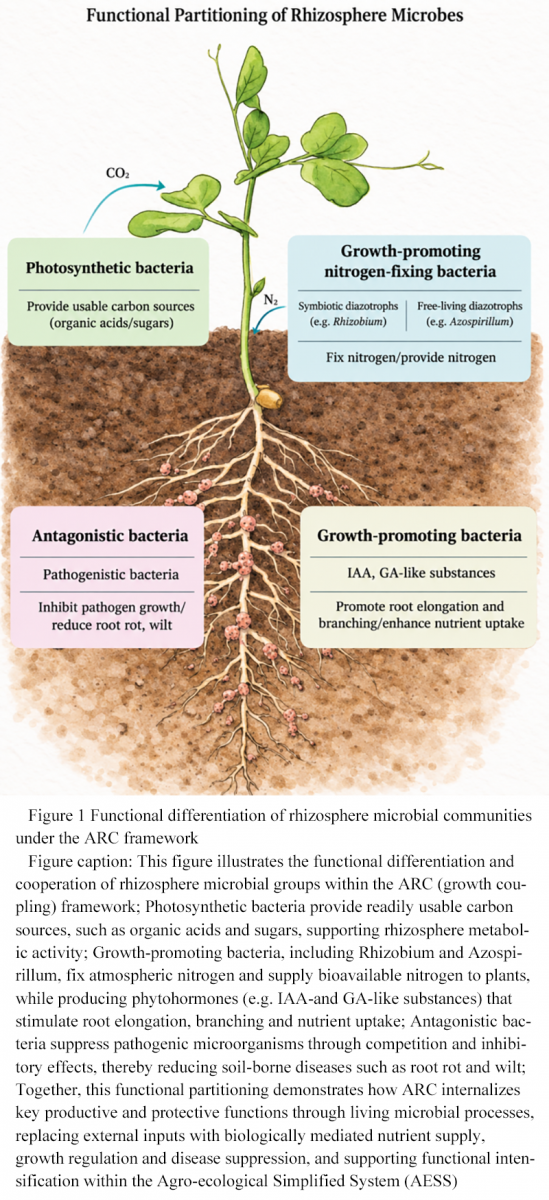
Based on existing research and field practice, the growth-promoting functions of ARC depend on at least one minimum functional unit (MFU), whose core comprises the following groups of functional microorganisms (Figure 1).
|
Figure 1 Functional differentiation of rhizosphere microbial communities under the ARC framework Figure caption: This figure illustrates the functional differentiation and cooperation of rhizosphere microbial groups within the ARC (growth coupling) framework; Photosynthetic bacteria provide readily usable carbon sources, such as organic acids and sugars, supporting rhizosphere metabolic activity; Growth-promoting bacteria, including Rhizobium and Azospirillum, fix atmospheric nitrogen and supply bioavailable nitrogen to plants, while producing phytohormones (e.g. IAA-and GA-like substances) that stimulate root elongation, branching and nutrient uptake; Antagonistic bacteria suppress pathogenic microorganisms through competition and inhibitory effects, thereby reducing soil-borne diseases such as root rot and wilt; Together, this functional partitioning demonstrates how ARC internalizes key productive and protective functions through living microbial processes, replacing external inputs with biologically mediated nutrient supply, growth regulation and disease suppression, and supporting functional intensification within the Agro-ecological Simplified System (AESS) |
1) Resource acquisition module
Nitrogen-fixing bacteria (such as rhizobia, Azospirillum, and certain members of the genus Bacillus) capture nitrogen resources within ARC by converting atmospheric nitrogen into ammonium or organically bound forms of nitrogen, thereby providing crops with relatively stable nitrogen inputs. They can partially substitute for chemical nitrogen fertilizers, with more pronounced effects when they coexist with other functional microorganisms (Igiehon and Babalola, 2018; Li et al., 2023; Timofeeva et al., 2023).
Phosphate-solubilizing and phosphorus-mineralizing microorganisms secrete organic acids and phosphatases to increase the bioavailability of soil phosphorus in fixed forms, providing an essential basis for subsequent growth and defense metabolism.
2) Root architecture and phytohormone regulation module
Root growth-promoting bacteria (such as certain members of the genus Bacillus and enterobacteria) regulate phytohormone levels, including those of indole-3-acetic acid (IAA) and cytokinins, to stimulate root elongation, branching, and root hair formation. This markedly expands rhizosphere volume and enhances water and nutrient uptake (Igiehon and Babalola, 2018; Li et al., 2023). This module determines the fundamental capacity of ARC to support early crop establishment and maintain homeostasis during the middle and later stages of crop development.
3) Antagonism and immune priming module
Antagonistic bacteria, such as members of the genera Pseudomonas and Chitinophaga, suppress soil-borne pathogens such as Rhizoctonia and Fusarium by producing antibiotics, siderophores, and cell wall-degrading enzymes. Through induced systemic resistance (ISR), they also prime the plant immune system (Igiehon and Babalola, 2018; Yin et al., 2021). This module not only lowers baseline disease pressure but also provides a physiological and immunological basis for subsequent defense coupling through ABD.
4) Carbon flow support and metabolic cross-feeding module
Under specific moisture and light conditions, photosynthetic bacteria and heterotrophic microbial groups with high metabolic activity can provide additional bioavailable carbon sources to the rhizosphere, enhance the overall metabolic activity of the microbial community, and promote rhizosphere carbon cycling and improvements in soil fertility (Timofeeva et al., 2023).
Together, these modules constitute the functional microbial core of ARC. The crucial factor is not simply the number of microbial species combined, but whether their functions can achieve complementarity and synergy across spatial and temporal scales.
This functional differentiation reflects a complementary structure shaped by the long-term evolution of rhizosphere ecosystems, rather than the result of artificial assembly. The central aim of ARC is not to construct an entirely new microbial community, but to amplify and stabilize these complementary relationships while respecting existing ecological constraints. Field studies have shown that long-term organic fertilizer substitution and targeted microbial inoculation can markedly reshape rhizosphere microbial community structure, enrich beneficial microbial groups, suppress pathogens, promote soil aggregate formation, and enhance root respiration (Schmidt et al., 2019; Liu et al., 2021; Liu et al., 2022).
At the same time, ARC explicitly rejects the “more is better” approach to inputs. If nitrogen-fixing bacteria occupy an excessive proportion of rhizosphere space, they may encroach on the ecological niches of root growth-promoting and antagonistic bacteria, thereby impairing root development or pathogen suppression. Excessive expansion of antagonistic bacteria may likewise suppress other beneficial microbial groups through competition for nutrients (Yin et al., 2021). Thus, coupling within ARC is fundamentally the management of dynamic balance in a multispecies network, rather than the simple addition of microbial species.
1.2 Restructuring of rhizosphere metabolic pathways and coupling of nitrogen and phosphorus cycling
Within ARC, microorganisms are not only participants in the rhizosphere environment but also the principal drivers of rhizosphere metabolic network restructuring. Rhizosphere metabolism is not a linear “uptake-transport” process, but a system of multiple cycles continuously influenced and regulated by microorganisms. Through the targeted introduction of microbial consortia with complementary functions, ARC can markedly modify rhizosphere nitrogen and phosphorus metabolic pathways, together with associated carbon metabolic pathways, within a relatively short period, thereby establishing an efficiently coupled nutrient self-cycling system (Lidbury et al., 2022; Timofeeva et al., 2023).
Nitrogen-fixing bacteria alter the forms of nitrogen and provide a stable source of nitrogen. Root growth-promoting bacteria regulate the amount and composition of root exudates, including organic acids, sugars, and amino acids, thereby strengthening pathways for carbon flow between plants and microorganisms and supplying energy and substrates to phosphate-solubilizing and phosphorus-mineralizing microorganisms (Han et al., 2025). Arbuscular mycorrhizal fungi (AMF) further improve nitrogen and phosphorus acquisition efficiency by expanding the absorptive area and enhancing nutrient exchange between roots and fungi, markedly increasing the ability of crops to adapt to low-nutrient environments (Igiehon and Babalola, 2018; Lidbury et al., 2022).
At the management level, organic fertilizer substitution, reduced deep plowing, and conservation tillage have been shown to markedly alter rhizosphere microbial community structure, promote nitrogen and phosphorus cycling, and improve soil health (Schmidt et al., 2019; Liu et al., 2021; Liu et al., 2022). Under low-nitrogen stress, inoculation with nitrogen-fixing bacteria can enrich functional microbial groups involved in amino acid, lipid, and carbohydrate metabolism, improving crop growth under nitrogen-limited conditions (Han et al., 2025). Studies in oilseed rape fields have further shown that the targeted activation of specific rhizosphere bacteria can markedly increase nitrogen and phosphorus mineralization rates, establishing a mechanism for synergistic nutrient utilization centered on microorganisms, roots, and soil (Lidbury et al., 2022).
The coupling of nitrogen and phosphorus cycling driven by ARC has two major implications. First, it enables crops to gradually move away from linear dependence on external chemical fertilizers and instead maintain nutrient supply through local nutrient cycles within the rhizosphere. Second, by strengthening C-N-P coupling, it increases the redundancy and homeostatic capacity of crop metabolic networks. This allows the system to maintain relatively stable growth despite nutrient fluctuations or environmental disturbances, creating favorable internal conditions for subsequent defense coupling through ABD (Liu et al., 2022; Domeignoz-Horta et al., 2024).
1.3 Farm case studies of ARC: application outcomes in Hainan and Zhejiang
The application of ARC in agricultural production has provided direct field evidence supporting its underlying mechanisms. In areca plantations and melon and fruit cropping systems in tropical Hainan, replacing approximately 30%~50% of chemical fertilizer inputs with ARC microbial formulations did not reduce yields; some fields instead achieved yield increases of approximately 10%~15%. More pronounced changes occurred in the soil: rhizosphere activity increased, soil aggregates became markedly more abundant, and fertilizer residues decreased. After several growing seasons, production systems with a long history of reliance on chemical fertilizers showed signs of self-recovery. Under hot and humid conditions, ARC supported a more stable nutrient supply, faster root renewal, and greater plant stress tolerance during the middle and later growth stages.
Rice-wheat systems in Zhejiang demonstrated the stability of ARC in a different ecological context. Fixed-site field trials showed that, when total fertilizer application was maintained or slightly reduced (the proportion of inorganic nitrogen replaced could exceed 20%), rice yields increased by 1.5%~3%, and a composite soil quality index improved by approximately 65% (Liu et al., 2021; He et al., 2022). Farmers commonly observed phenotypic changes, including whiter roots, more fine roots, and greater lodging resistance during later growth stages. In wheat systems, microbial formulations and organic fertilizer substitution likewise markedly increased yields and nitrogen use efficiency and improved soil organic matter content and available nutrient levels (He et al., 2022).
The two regional cases shared a common microbiological feature: the introduction of nitrogen-fixing and phosphate-solubilizing bacteria was closely associated with greater microbial diversity, higher soil enzyme activity, and improved nutrient use efficiency (Liu et al., 2021; He et al., 2022; Liu et al., 2022). This indicates that the core mechanisms of ARC do not depend on a specific climatic zone or crop type, but are based on a broadly applicable coupling relationship linking functional microbial groups, rhizosphere metabolism, and soil structure.
1.4 A model of ARC effects: from nutrient self-cycling to system homeostasis
The goal of ARC is not simply to increase yield, but to establish a homeostatic system capable of sustained operation through nutrient self-cycling, enhanced photosynthetic efficiency, and the maintenance of microbial diversity. In this model, N, P, and C flows form the central framework: functional microbial groups drive nutrient transformations, root exudates and photosynthates supply microorganisms with carbon, and root growth-promoting bacteria improve root architecture and enhance exudation capacity, enabling the system to maintain high activity across time and space (Lidbury et al., 2022; Timofeeva et al., 2023; Daunoras et al., 2024).
As these cycles continue to operate, crops gradually shift from passive dependence on external inputs to active regulation of the rhizosphere metabolic environment, with marked improvements in system homeostasis and resistance to disturbance. Increased microbial diversity further enhances system resilience, allowing other microbial groups to sustain key processes even when some functions are impaired (Yin et al., 2021; Liu et al., 2022; Domeignoz-Horta et al., 2024). This homeostatic structure provides a solid ecological foundation for subsequent synergy between ARC and ABD.
2 Ecological Mechanisms of Defense Coupling in ABD
Agro-Biological Defense (ABD) is not a single-point control strategy aimed at completely eliminating pests or pathogens, but a defense system centered on crop ecological immunity that regulates pest and pathogen pressure through the coordinated action of biological components at multiple levels. Within this system, defense is viewed as a dynamic, self-regulating process involving molecular, microbial, and community levels. Its aim is to keep damage caused by pests and pathogens consistently within thresholds that crops and ecosystems can tolerate over the long term, thereby reducing structural dependence on chemical pesticides (Malik et al., 2020; Tiwari, 2024).
2.1 The four core modules of ABD: from molecular control to ecological regulation
ABD comprises four functionally complementary core modules operating on different timescales: Bt technology, RNA interference (RNAi), communities of biocontrol microorganisms, and natural enemy networks. These modules act at different levels of the crop defense system (Figure 2), together forming an ecological defense network coupled across multiple levels (Caccia et al., 2019; Malik et al., 2020; Gassmann and Reisig, 2022; Tiwari, 2024).
|
Figure 2 Schematic diagram of the spatial and functional positioning of the four core ABD modules within the crop defense system Figure caption: This figure illustrates the spatial, functional and temporal organization of core modules within the Agro-Biotic Defense Coupling (ABD) framework; ABD integrates defense mechanisms across molecular, individual, community and agroecosystem scales to form a layered system-level immune architecture; At the molecular and individual level, Bt- and RNAi-based genetic defenses act during early latent phases of pest and pathogen development, reducing initial establishment and population build-up; At intermediate scales, biological barriers mediated by microbial antagonism and induced resistance restrict pathogen spread; At the agroecosystem and community level, natural enemy networks regulate pest populations during peak outbreak periods through predation and parasitism; The spatial and temporal complementarity among these modules enables risk buffering, shock absorption and resilience through redundancy, allowing crop protection to emerge from coordinated biological processes rather than continuous chemical intervention |

2.1.1 Molecular level: the targeted suppression module comprising Bt and RNAi
At the molecular level, Bt technology and RNAi constitute the rapid-response module of ABD. Bt technology uses transgenic crops or Bt-based biopesticides to deliver specific toxins to target pests as they feed on the plants, enabling rapid, targeted population suppression during periods of high pest pressure and markedly reducing reliance on broad-spectrum chemical insecticides (Gassmann and Reisig, 2022). However, numerous studies have shown that long-term use of Bt alone may drive the evolution of pest resistance, necessitating a shift in control strategies from reliance on a single intervention to system integration (Guo et al., 2022; Guo et al., 2023).
RNAi-mediated regulation involves the delivery of double-stranded RNA (dsRNA) to selectively silence key genes involved in physiological processes or immune responses in pests or pathogens, inducing lethal or sublethal effects. In addition to reducing risks to non-target organisms through its high specificity, RNAi can markedly enhance the toxicity of Bt toxins by disrupting the pest immune system, generating synergy at the molecular level (Caccia et al., 2019; Niu et al., 2023). Experimental studies have shown that dietary supplementation with bacteria expressing immunosuppressive dsRNA can markedly increase the susceptibility of pests such as Spodoptera littoralis to Bt, providing a mechanistic basis for Bt-RNAi integration (Caccia et al., 2019; Yang et al., 2022).
Within the ABD framework, Bt and RNAi are not regarded as the dominant long-term control measures; instead, they are intended to provide short-term, highly effective, targeted suppression when pest populations approach or exceed the economic threshold. The intensity and frequency of their use must be constrained by the other ecological modules.
2.1.2 Ecological level: homeostatic regulation by biocontrol microorganisms and natural enemy networks
In contrast to the “fast variables” at the molecular level, biocontrol microorganisms and natural enemy networks represent the “slow variables” of ABD and constitute its homeostatic regulation module. Biocontrol microorganisms, including beneficial bacteria and fungi, directly suppress pathogens and trigger systemic acquired resistance (SAR) or induced systemic resistance (ISR) in plants through the production of antibiotics, cell wall-degrading enzymes, volatile organic compounds, and various immune elicitors. These processes establish persistent “biological barriers” in the rhizosphere and on leaf surfaces (Malik et al., 2020; Nishad et al., 2020).
Natural enemy networks include predatory insects, parasitoid wasps, and entomopathogenic fungi and viruses. They regulate pest population structure through predation, parasitism, and behavioral interference. When chemical pesticide use is reduced, plants providing floral resources are optimally arranged, and habitat structure is optimized, natural enemy networks can maintain the ecological balance of pest populations at the field scale over the long term and markedly improve system stability (Tiwari, 2024; Vasantha-Srinivasan et al., 2025).
2.1.3 Self-organizing defense networks: synergy among modules rather than sequential addition
In practice, the four core modules of ABD are not activated sequentially according to a stepwise procedure; instead, they operate more like a self-organizing defense network. Bt and RNAi provide rapid suppression during periods of peak pest abundance; biocontrol microorganisms continuously reduce baseline pathogen and pest pressure throughout the crop growth cycle; and natural enemy networks maintain long-term ecological regulation across spatial and temporal scales.
Evidence from vegetable and cotton fields shows that, while biocontrol microorganisms in the rhizosphere and on leaf surfaces continuously suppress disease, parasitoid wasps and predatory natural enemies already exert background suppression on potential pests. Bt and RNAi provide targeted supplementary interventions around the time pest populations approach the economic threshold, forming an integrated defense system with staggered timing and complementary mechanisms (Malik et al., 2020; Gassmann and Reisig, 2022; Tiwari, 2024). The control efficacy of ABD stems from system homeostasis jointly shaped by modules at multiple levels, rather than from any single “powerful technology.”
2.2 Multidirectional coupling among crops, control agents, pests/pathogens, and the environment
The defense logic of ABD is not limited to countering pests or suppressing pathogens; it is based on multidirectional coupling among crops, control agents, pests and pathogens, and environmental conditions. Crops are active nodes in this defense system: their epidermal cuticles and cell walls form the first physical barrier, diverse secondary metabolites form a chemical line of defense, and signaling pathways mediated by jasmonic acid (JA), salicylic acid (SA), and ethylene (ET) coordinate induced immune responses (Zhang et al., 2019; Malik et al., 2020).
Pests and pathogens engage in counter-defense through effector proteins and cross-kingdom small RNAs (sRNAs). Recent research has shown that small RNA effectors from some herbivorous insects can enter plant cells and suppress the expression of key genes in the SA and JA pathways through cross-kingdom gene silencing, thereby weakening plant defenses (Han et al., 2025). In this dynamic process, ABD acts through interventions at multiple points to stabilize the balance between attack and defense in favor of crops (Malik et al., 2020; Tiwari, 2024).
Environmental factors are not merely a passive backdrop in ABD. Bt toxins are susceptible to degradation by ultraviolet radiation, and the duration of their efficacy in the field is closely related to light exposure and application timing; dsRNA stability decreases at high temperatures and in nuclease-rich environments; and the activity of biocontrol microorganisms and natural enemies depends strongly on temperature, humidity, and field structure (Gassmann and Reisig, 2022; Niu et al., 2023; Tiwari, 2024). Thus, the control efficacy of ABD is fundamentally shaped by both biological factors and environmental conditions.
2.3 Empirical evidence: synergy among modules rather than replacement by a single technology
A substantial body of empirical research supports the complementary roles of ABD modules in system-level defense. Bt crops markedly reduce target pest densities and chemical insecticide use at the regional scale, but the evolution of resistance indicates that they must be used in conjunction with other modules (Gassmann and Reisig, 2022; Guo et al., 2022). Under experimental conditions, RNAi can markedly increase pest mortality and reduce fecundity, while also enhancing Bt toxicity (Caccia et al., 2019; Yang et al., 2022). Biocontrol microorganisms can reduce disease incidence by tens of percentage points in various cropping systems while inducing plant immunity and promoting growth (Malik et al., 2020; Nishad et al., 2020). Long-term monitoring of natural enemy networks indicates that, under appropriate management, these networks can markedly enhance system resilience and suppress pest outbreaks (Tiwari, 2024).
Together, these findings indicate that ABD does not replace chemical control with a single technology. Instead, through synergy among multiple modules operating on different timescales, it establishes a stable ecological defense system that can be regulated.
2.4 Ecological immunity model of ABD: multilayered barriers and dynamic homeostasis
The ecological immunity model of ABD can be summarized in terms of three nested spatial levels (Figure 2):
Rhizosphere level: Biocontrol microorganisms form the first line of defense through competition, antagonism, and immune induction, while also regulating nutrient and hormone balance (Malik et al., 2020).
Leaf-surface level: Bt, RNAi, and leaf-surface microorganisms act directly on pests feeding on plants and on foliar pathogens, forming the second line of defense together with induced plant immunity (Zhang et al., 2019).
Community level: Natural enemy networks and agricultural landscape structure form the third ecological barrier, stabilizing pest population dynamics (Tiwari, 2024).
Plant volatile organic compounds (VOCs) and microbially induced signals transmit defense information between levels, giving the system the capacity for early warning and priming (Vasantha-Srinivasan et al., 2025). From a dynamic systems perspective, ABD is better viewed as a self-regulating immune network than as a rigid system aimed at achieving “zero pests.” ARC provides the physiological and metabolic foundation, while ABD regulates defense across multiple levels; together, they form the core framework for subsequent research on their synergy.
2.5 Resistance management and failure boundaries of ABD: from technological risk to system regulation
Although synergy among multiple modules enables ABD to markedly reduce dependence on any single control technology, its long-term effectiveness remains inevitably constrained by resistance evolution, ecological disturbance, and management mismatches. Clarifying the logic of resistance management in ABD and its potential failure boundaries is therefore a key prerequisite for its transition from a combination of technologies to a sustainable defense system.
2.5.1 System-level sources of resistance risk
Resistance risk is unevenly distributed among the four core modules of ABD and is concentrated primarily in the molecular-level Bt and RNAi modules. Numerous studies have shown that pests can develop resistance to Bt toxins through receptor mutations, changes in detoxification enzyme expression, remodeling of immune pathways, epigenetic regulation, and other mechanisms (Guo et al., 2022; Guo et al., 2023). Although RNAi is highly specific, its long-term control efficacy may be affected by dsRNA uptake efficiency and stability, as well as the integrity of the RNAi pathway within pests (Niu et al., 2023).
By contrast, the risk of resistance to biocontrol microorganisms and natural enemy networks is markedly lower. These modules do not act on pests or pathogens through a single toxic mechanism. Instead, they continuously impose selection pressures through multiple ecological processes-competition, antagonism, parasitism, predation, and immune induction-making it difficult for harmful organisms to gain a system-wide advantage through a single mutation (Malik et al., 2020; Tiwari, 2024). Thus, from a system perspective, resistance risk in ABD exhibits pronounced heterogeneity among modules.
2.5.2 Resistance buffering mechanisms of ABD
The key advantage that distinguishes ABD from conventional chemical control or a single biological technology lies in its inherent resistance buffering mechanisms, which operate in three main ways:
1) Multiple mechanisms operating in parallel reduce the concentration of selection pressure
Differences among Bt, RNAi, biocontrol microorganisms, and natural enemy networks in their modes of action, timescales, and spatial levels make prolonged exposure of pests or pathogens to a single, stable selection pressure less likely, thereby markedly reducing the likelihood of rapid resistance accumulation (Gassmann and Reisig, 2022).
2) Differences in timescales delay resistance fixation
Bt and RNAi are mainly deployed briefly during periods of high pest pressure, whereas biocontrol microorganisms and natural enemy networks maintain background suppression throughout the crop growth cycle. This temporal offset between “fast” and “slow” variables makes it difficult for resistance genes to spread rapidly through pest populations under stable environmental conditions (Malik et al., 2020).
3) Ecological complexity increases the fitness costs of resistance
In agroecosystems with relatively high biodiversity and structural complexity, even when pests acquire resistance to a particular control agent, the associated fitness costs often manifest as reduced growth, reproduction, or competitive ability, limiting the fixation of resistance within the population over the long term (Tiwari, 2024).
In this sense, ABD does not eliminate resistance, but uses system design to delay its evolution and reduce the extent to which it manifests at the ecological level.
2.5.3 Typical failure boundaries of ABD
Despite its capacity to buffer resistance risk, ABD still has clear failure boundaries, primarily in the following scenarios:
1) Disruption of the ecological foundation
When prolonged, intensive use of broad-spectrum chemical pesticides causes natural enemy networks to collapse and hinders colonization by biocontrol microorganisms, ABD is reduced to reliance on Bt or RNAi alone, and resistance risk rises markedly (Gassmann and Reisig, 2022).
2) Mismatched management timing
Frequent application of Bt or RNAi when pest densities are low instead artificially amplifies selection pressure in the absence of ecological suppression, accelerating resistance development and weakening the long-term effectiveness of ABD.
3) Extreme environmental conditions
Under extremely high temperatures, intense ultraviolet radiation, or frequent extreme climatic events, dsRNA stability declines, the activity of biocontrol microorganisms is constrained, and natural enemy populations fluctuate more strongly. These effects may temporarily destabilize the synergistic structure of ABD (Niu et al., 2023; Vasantha-Srinivasan et al., 2025).
4) Inadequate support from ARC
If crop rhizosphere health is impaired and overall plant physiological condition is poor, immune induction and defense responses within ABD often cannot function to their full potential, reducing control efficacy. This failure boundary highlights the dependence of ABD on the physiological and metabolic foundation provided by ARC.
2.5.4 From resistance management to system regulation
Based on this analysis, resistance management in ABD should be viewed as a matter of system-level regulation, rather than simply the rotation of technologies or replacement of toxins. The core strategies include:
Positioning Bt and RNAi explicitly as threshold-based tools rather than inputs for continuous use;
Maintaining long-term background ecological suppression through biocontrol microorganisms and natural enemy networks;
Using ARC to improve crop health and enhance immune priming, thereby reducing the required intensity of control;
Introducing insect pest monitoring and digital decision-making systems, where conditions permit, to dynamically adjust control strategies.
Within this framework, ABD no longer aims for “zero pests and diseases”; instead, it seeks to establish an ecological defense system in which resistance evolves slowly, system resilience is high, and management can be adjusted. A clear understanding of these failure boundaries also provides an important basis for risk control in subsequent research on ARC-ABD synergy and regional deployment.
3 Synergistic Effects of ARC and ABD
The synergy between ARC and ABD is not a simple additive combination of growth promotion and defense operating in parallel, but an indirect amplification process mediated by rhizosphere health and whole-plant physiological homeostasis. Within this framework, ARC first reshapes rhizosphere microecology and crop metabolic status, markedly enhancing plant responsiveness to defense inputs. ABD, in turn, reinforces the establishment and persistence of the ARC microbial system by stabilizing pest and pathogen pressure and reducing chemical disturbance. Together, the two form a directional positive feedback network (Figure 3).
|
Figure 3 Indirect pathways through which ARC-induced rhizosphere engineering enhances ABD defense efficiency Figure caption: This figure illustrates how ARC-induced rhizosphere engineering indirectly enhances the efficiency of Agro-Biotic Defense Coupling (ABD) by improving rhizosphere health and overall plant physiological status; ARC promotes the formation of beneficial microbial consortia composed of nitrogen-fixing, phosphate-solubilizing and degrading bacteria, together with mycorrhizal fungi; These consortia optimize root architecture, enhance nutrient uptake and modulate root exudation patterns, thereby reshaping rhizosphere conditions; Through targeted introduction of ARC microbial inoculants and the directional construction of advantageous plant-microbe interfaces, rhizosphere microbial activity and diversity are increased, resulting in more vigorous and resilient host plants; Improved plant physiological condition provides a critical ecological and biological foundation for genetic, microbial and community-level defenses within ABD, enabling stronger system-level immunity and more stable risk buffering without increasing reliance on external chemical inputs |

3.1 Systemic improvement of whole-plant physiological status by ARC
The growth-promoting effects of ARC first become evident in the functional reactivation of the rhizosphere. Once rhizosphere consortia comprising plant growth-promoting rhizobacteria (PGPR), mycorrhizal fungi, and other functional microorganisms become stably established, roots exhibit markedly enhanced capacities for uptake, respiration, and exudation. Crops generally show more vigorous early growth, characterized by whiter roots, more fine roots, greater root hair density, and an expanded rhizosphere volume (Vejan et al., 2016; Hakim et al., 2021; Yusuf et al., 2025). These morphological and physiological changes determine the capacity of crops to buffer the effects of subsequent nutrient fluctuations, drought, and biotic stress.
Mechanistically, ARC is essentially an engineering approach to regulating the rhizosphere as an “extended root phenotype.” Through inoculation with purpose-designed microbial consortia and modulation of root exudate profiles, ARC restructures rhizosphere nutrient cycling, signal transduction, and microbial network structure (De La Fuente Cantó et al., 2020; Hakim et al., 2021). Beneficial microorganisms improve nutrient availability through nitrogen fixation, phosphate solubilization, and potassium solubilization. They also secrete secondary metabolites and signaling molecules that continuously induce metabolic pathways associated with plant immunity, thereby enhancing growth and stress tolerance in parallel (Mhlongo et al., 2018; Kong and Liu, 2022; Thepbandit and Athinuwat, 2024).
Root exudates play a key mediating role in this process. Organic acids, sugars, amino acids, and other compounds not only sustain microbial activity as carbon sources but also shape rhizosphere community structure by selectively recruiting beneficial microbial groups, forming a stable, mutually beneficial plant-microorganism system (Hu et al., 2018; Mhlongo et al., 2018). The resulting rhizosphere environment, characterized by high metabolic activity, enables crops to gradually move away from the passive cycle of nutrient deficiency followed by external supplementation, providing a solid physiological foundation for the effective functioning of ABD defense modules.
3.2 ARC enhances ABD defense efficiency through immune priming
ARC enhances ABD performance by improving the quality of crop responses to defense signals through immune priming and improved metabolic homeostasis, rather than by directly increasing lethality. Numerous studies have shown that beneficial rhizosphere microorganisms can trigger induced systemic resistance (ISR) and promote regulatory crosstalk between ISR and systemic acquired resistance (SAR), thereby markedly upregulating defense gene expression and optimizing the dynamic balance among signaling pathways such as those mediated by salicylic acid (SA), jasmonic acid (JA), and ethylene (ET) (Hu et al., 2018; Mhlongo et al., 2018; Dlamini et al., 2022).
In this state, the crop defense system is in a low-cost state of readiness rather than a state of metabolically demanding activation. When ABD modules such as Bt, RNAi, biocontrol microorganisms, or natural enemy networks are deployed, they no longer represent external pressures on vulnerable plants; instead, they function more as triggers of an already primed defense network. Plants with healthy rhizospheres, relatively high photosynthetic efficiency, and a well-maintained hormonal balance can initiate defense responses more rapidly in response to pest feeding or pathogen infection. They can also maintain relatively stable levels of growth-related metabolism during defense, thereby markedly improving ABD control efficacy and prolonging its effects (Thepbandit and Athinuwat, 2024; Yusuf et al., 2025).
Thus, the key contribution of ARC lies not in directly controlling pests, but in increasing the effectiveness per unit of defense input: ABD measures applied at the same intensity often yield greater and more consistent defense benefits in plants in good physiological condition. This mechanism explains why control intensity can be reduced while overall control efficacy increases in the ARC + ABD system.
3.3 Reciprocal reinforcement of the ARC microbial system by ABD
The synergy between ARC and ABD is not unidirectional. By stabilizing pest and pathogen pressure and reducing chemical disturbance, ABD creates the conditions necessary for ARC microbial communities to become established and thrive over the long term. Previous research has shown that prolonged, intensive use of broad-spectrum pesticides markedly reduces soil microbial diversity and suppresses the colonization and functional activity of beneficial microorganisms such as PGPR and mycorrhizal fungi, thereby undermining the long-term effectiveness of ARC (Vishwakarma et al., 2020; Hakim et al., 2021).
When ABD maintains pest and pathogen pressure at relatively low levels through Bt, biocontrol microorganisms, RNAi, and natural enemy networks and markedly reduces chemical intervention, the external shocks experienced by rhizosphere microbial communities are substantially reduced. Reduced physical damage to roots caused by harmful organisms allows crops to allocate more photosynthates to root growth and root exudate synthesis, thereby enhancing the carbon supply to beneficial rhizosphere microorganisms (Hu et al., 2018; Kong and Liu, 2022). This process provides an indirect pathway through which ABD promotes ARC: ABD does not regulate microorganisms directly, but improves plant health and environmental stability, enabling the ARC microbial system to function continuously and undergo further optimization.
From the perspective of ecological succession, when pest and pathogen pressure and chemical disturbance are controlled over the long term, rhizosphere microbial communities are no longer frequently “reset.” Instead, they gradually develop stable structures with functional redundancy and the capacity for self-organization, reflected in improved soil aggregation, increased enzyme activity, and more efficient nutrient cycling (De La Fuente Cantó et al., 2020; Hakim et al., 2021). These changes further strengthen the effects of ARC on growth promotion and stress tolerance, setting the system on a positive trajectory of ecological succession.
3.4 Biological positive feedback and system homeostasis in ARC-ABD
When ARC and ABD operate synergistically within the same system, they form a directional biological positive feedback loop:
Enhanced rhizosphere activity → improved plant physiological homeostasis → easier activation of the defense system → reduced pest and pathogen pressure → improved microbial habitats → further enhancement of rhizosphere function (Figure 3).
This process is not merely additive, but represents a “snowballing” pattern of system evolution. Beneficial rhizosphere microorganisms play dual roles as “initiators” and “sustainers”: they promote growth through nutrient supply and hormonal regulation while improving the efficiency of defense responses through immune priming (Hu et al., 2018; Mhlongo et al., 2018). Once ABD modules reduce pest and pathogen pressure, the system experiences less disturbance, allowing rhizosphere carbon flow and microbial community structure to recover more readily and undergo further optimization. This, in turn, enhances the system’s capacity to withstand and recover from subsequent stresses (De La Fuente Cantó et al., 2020; Yusuf et al., 2025).
This capacity for recovery and self-reinforcement is an important hallmark of sustainable agricultural systems. In contrast to rigid control systems dependent on intensive chemical inputs, the ARC + ABD synergistic system more closely resembles an ecosystem with a resilient equilibrium. Even after extreme climatic events or pest outbreaks, it can recover within a relatively short period to a production level close to, or even higher than, its previous level.
3.5 Field evidence: synergistic performance in different ecological contexts
Trials in areca plantations in Hainan provide representative evidence of ARC-ABD synergy. In a hot and humid environment with highly variable pest and pathogen pressure, applying ARC microbial formulations over several consecutive growing seasons markedly enhanced rhizosphere activity and plant vigor. Complementary Bt-based pest control maintained lepidopteran pest populations at consistently low densities. Monitoring results showed yield increases of approximately 8%~12% with ARC alone, compared with nearly 20% when ARC was combined with Bt, indicating that ARC-mediated improvements in plant physiological condition markedly amplified the control benefits of ABD (Qaim and Janvry, 2005; Yusuf et al., 2025).
Rice-based systems in Zhejiang illustrate a different pathway of synergy. ARC improves rhizosphere health and soil functioning, while regulation by natural enemies within ABD stabilizes pest communities at the field scale, allowing the system to maintain relatively high productivity under reduced fertilizer and pesticide inputs. Key pests were effectively suppressed through the combined effects of natural enemy networks and reduced pesticide use, and chemical pesticide use decreased by 30%~40%. Meanwhile, ARC microbial consortia formed stable structures in the rhizosphere, and the numbers of rice tillers and productive panicles increased markedly, with yield increases of 5%~10% in some demonstration fields (Hakim et al., 2021).
Despite differences in ecological context and crop type, the two regional cases show a consistent trend: ARC enhances system potential by establishing sound rhizosphere and physiological foundations, while ABD preserves the ecological environment and maintains defense homeostasis by stabilizing pest and pathogen pressure. Their synergy drives the transition of agricultural systems toward lower inputs, greater efficiency, and higher resilience.
4 Technology Integration and Deployment Pathways
Although ARC and ABD have shown clear potential for synergy at the mechanistic level, their transition from trials and demonstrations to large-scale application hinges not on further combining the performance gains of individual technologies, but on embedding biological processes in an engineered system that can be regulated, evaluated, and replicated. In this process, the digital infrastructure provided by smart agriculture is a key hub linking ARC’s biological mechanisms for growth promotion with ABD’s ecological defense system, rather than an optional add-on (Sharma et al., 2022; Gebresenbet et al., 2023; Miller et al., 2025).
4.1 Integrated architecture of ARC + ABD + smart agriculture
In the integrated ARC + ABD + smart agriculture model (Figure 4), the biological modules of ARC and ABD are embedded within a digital module comprising sensor networks, the Internet of Things (IoT), remote sensing, and artificial intelligence (AI), forming a closed-loop system that combines data-driven operation, model-based decision-making, and feedback optimization.
|
Figure 4 Integrated architecture linking ARC, ABD and smart agriculture across biophysical, algorithmic and governance layers Figure caption: This figure illustrates an integrated architecture that connects ARC (growth coupling) and ABD (biotic defense coupling) with smart agriculture across biophysical, algorithmic and governance layers, At the biophysical layer, ARC and ABD operate through life-based processes that regulate productivity, immunity and risk buffering, At the algorithms and models layer, biological and management data are translated into optimized input structures, reduction targets and spatial promotion strategies. At the management and policy layer, model outputs support farm management, spatial planning and regulatory decision-making through aggregated and visualized reports, scenario analysis, and incentive mechanisms; Rather than replacing ecological processes, smart agriculture functions as a connector and amplifier that enables life-based production and risk governance capacities to be operationalized, governed and scaled within the Agro-ecological Simplified System (AESS) |

Within this architecture, data on crop rhizosphere activity, soil physicochemical properties and microbial status, pest and pathogen dynamics, and environmental variables-including temperature, humidity, radiation, and soil moisture-can be continuously collected from multiple monitoring sources and integrated and analyzed on a cloud platform (Gebresenbet et al., 2023; Miller et al., 2025). Unlike conventional management that relies on experience-based judgments, this system emphasizes quantitative decision support for determining when to apply inputs, which inputs to apply, and how much to apply:
Digital support for ARC: Soil moisture, electrical conductivity, temperature, and selected indicators of enzyme activity or metabolism can guide the application timing, rates, and combinations of rhizosphere microbial formulations, helping to avoid the risks of low efficacy or failure associated with indiscriminate inoculation.
Digital support for ABD: Insect pest monitoring, image recognition, and remote sensing can track pest densities and spatial distributions in real time, allowing measures such as Bt, RNAi, biocontrol formulations, and natural enemy releases to be initiated precisely when pest densities approach the economic threshold, rather than as remedial measures after the fact (Sharma et al., 2022; Elbeheiry and Balog, 2023).
By embedding the biological regulation modules of ARC and ABD within a digital platform, this integrated architecture can deliver three core functions:
(1) Site-specific ARC management: Tailoring rhizosphere consortia and application plans to field-level soil and microbial data;
(2) Optimized timing of ABD control: Dynamically adjusting control schedules based on pest and disease information and weather forecasts;
(3) Efficient resource use: Coordinating with precision irrigation and variable-rate fertilizer application to reduce redundant inputs and environmental burdens (Gebresenbet et al., 2023).
A particularly important feature of this approach is its considerable scalability and capacity for self-learning. As data continue to accumulate, the models can continually refine their parameters and improve predictive accuracy, generating ARC-ABD integration plans that are better adapted to local conditions for farms in different ecological zones and at different scales of operation. This supports a shift from experience-driven to model-driven agricultural management (Miller et al., 2025).
4.2 Tiered deployment pathways: from applications with low entry barriers to intelligent systems for ARC-ABD synergy
To prevent high technical barriers from limiting adoption, ARC + ABD integration can follow a tiered deployment strategy:
1) Basic tier (low digital requirements)
For small- and medium-scale farmers or those in less-developed regions, priority can be given to combining ARC microbial formulations with biocontrol microorganisms and regulation by natural enemies within ABD. This approach can deliver direct benefits by reducing chemical inputs and improving rhizosphere health, without requiring complex sensors or algorithmic support.
2) Enhanced tier (moderate digitalization)
For large-scale farms, insect pest monitoring, weather stations, and basic decision support systems can be introduced to optimize the timing of Bt and RNAi interventions and ARC management, markedly improving the output-to-input ratio.
3) Advanced tier (intelligent systems for ARC-ABD synergy)
In regions with highly intensive agriculture, AI platforms can integrate data from multiple sources to enable microbial customization, pest risk prediction, and the dynamic allocation of inputs, providing a technological template for the transition to green agriculture at the regional scale.
This tiered pathway can facilitate the gradual diffusion of ARC-ABD technologies across different economic and technological contexts, offering an alternative to high-risk attempts at full deployment in a single step.
4.3 Synergistic development of intelligent microbial design and innovation in ABD resources
4.3.1 AI-driven design of microbial consortia
Conventional microbial formulations typically have fixed compositions, limiting their adaptability to different soil, crop, and climatic conditions. Advances in metagenomics, synthetic biology, and machine learning have made the targeted design of context-specific synthetic microbial communities (SynComs) possible (De Souza et al., 2020; Karkaria et al., 2020).
By integrating metagenomic, transcriptomic, phenomic, and environmental data, AI models can identify key functional strains and their interactions and screen a vast combinatorial space for microbial community designs that combine stability with high efficiency (Thompson et al., 2022; Gong et al., 2024). This enables ARC to shift gradually from generic formulations to field-level customization, with dynamic adjustments based on real-time monitoring results.
4.3.2 Localized innovation and optimized integration of Bt resources in ABD
The long-term effectiveness of ABD depends on continuous innovation in and local adaptation of biocontrol resources such as Bt. Genomics and protein engineering provide opportunities to develop novel Bt strains and toxins with improved target specificity, more consistent control efficacy, and advantages for resistance management (Karmakar et al., 2025; Tariq et al., 2025).
With support from digital platforms, the application of Bt resources can be tailored to pest spatial distributions and resistance risk. Feedback data can be used to continually optimize ABD management strategies and help avoid excessive reliance on a single control agent (Sharma et al., 2022).
4.4 Digital platforms as infrastructure for ARC-ABD integration
As multisource sensing and remote sensing technologies become more widespread, digital management platforms are becoming the infrastructure supporting ARC-ABD technology integration and large-scale deployment. These platforms typically provide the following functions:
Data aggregation and visualization: Integrating soil, crop, insect pest, and weather data for field-level visualization (Gebresenbet et al., 2023);
Model-based prediction and decision support: Providing intelligent recommendations for ARC and ABD application strategies (Sharma et al., 2022; Elbeheiry and Balog, 2023);
Traceability and compliance management: Supporting green certification and helping meet regulatory requirements, thereby enhancing market acceptance (Elbeheiry and Balog, 2023).
As intelligent microbial design, localized innovation in ABD resources, and digital platform governance develop synergistically, ARC-ABD synergy can be continuously optimized within individual farms and more readily replicated and scaled up at regional and even national scales. This integration pathway, jointly driven by ecological science, the life sciences, and digital technologies, constitutes a key engineering framework for implementing the Agroecological Simplified System (AESS) in real-world settings.
5 Conclusions and Outlook
This study systematically analyzed the synergistic mechanisms and practical pathways of Agroecological Rhizospheric Coupling (ARC) and Agro-Biological Defense (ABD). The findings indicate that maintaining yields and stability in agricultural production does not necessarily require intensive chemical fertilizer and pesticide inputs. By restructuring rhizosphere microbial networks, activating endogenous metabolic regulation in crops, and introducing ecological defense mechanisms at multiple levels, agricultural systems may gradually shift from a mode dominated by external chemical inputs to one driven by endogenous biological processes. Under this model, crop productivity, the restoration of soil fertility, and the regulation of pest and pathogen pressure are no longer determined by a single input, but are supported by system homeostasis shaped through synergy among rhizosphere consortia, immune priming, and ecological networks.
The core value of ARC-ABD synergy lies in the directional positive feedback mechanism it establishes, rather than in improving the performance of any single technology. ARC markedly enhances the efficiency of crop responses to defense inputs by improving rhizosphere health and whole-plant physiological homeostasis. ABD, in turn, reinforces the establishment and long-term functioning of the ARC microbial system by stabilizing pest and pathogen pressure and reducing chemical disturbance. Field cases, including those from areca plantations in Hainan and rice-based systems in Zhejiang, show that, under reduced fertilizer and pesticide inputs, this synergy can simultaneously stabilize or increase yields, improve soil physicochemical properties and microbial status, and sustain the suppression of damage caused by pests and pathogens across different ecological contexts, demonstrating its potential for broad applicability across crop types and climatic zones.
At the same time, this study makes clear that ARC-ABD synergy is not a universal solution that works automatically. The system involves coupled processes across multiple scales, including rhizosphere microbial succession, restructuring of nutrient metabolism, regulation of plant immunity, adaptation by pests and pathogens, and environmental fluctuations. Its performance depends strongly on the ecological foundation, management timing, and the intensity of external disturbances. Short-term observations or single-site trials alone provide an insufficient basis for long-term optimization and large-scale deployment. There is an urgent need for future research to use systems modeling and scenario simulation to integrate key processes at the molecular, individual, community, and field scales within a unified analytical framework. This would provide a quantitative basis for ARC-ABD combination strategies, application intensity, and the timing of management interventions, while clarifying resistance management strategies and failure boundaries.
From the perspective of technological development, further progress in ARC-ABD depends on improved capacities for dynamic monitoring and regulation. Developing temporal monitoring systems for rhizosphere microbial communities, plant hormones, and immune signaling networks and combining them with network analysis and machine learning may help identify critical transition points, including those between growth and defense and between symbiosis and imbalance, and translate complex biological processes into actionable risk indicators and management thresholds. At the same time, regional trials and long-term observations are still needed to repeatedly evaluate ARC-ABD approaches across different climatic zones, soil types, and cropping systems, so that technical pathways can be adapted to local conditions rather than based on a single “universal template”.
From a longer-term perspective, ARC-ABD synergy represents more than the integration of a set of biological or digital technologies; it points to a fundamental transformation in the agricultural production paradigm-from agriculture centered on chemical inputs and immediate control to the Agroecological Simplified System (AESS), which places the capacities of living systems for self-organization and self-regulation at its core. As rhizosphere engineering, the regulation of ecological immunity, smart agriculture platforms, synthetic biology, and AI-driven microbial design continue to converge, a more resilient, environmentally friendly agricultural system capable of self-repair is gradually emerging. In this process, ARC-ABD synergy has the potential to become a key hub connecting fundamental biological processes with engineering-based agricultural practice, offering a feasible pathway toward green high-yield agriculture worldwide amid resource constraints and climatic uncertainty.
Authors’ Contributions
Xuanjun Fang was the executor of this study, responsible for literature review and data analysis, as well as the drafting and revision of the manuscript. The author read and approved the final manuscript.
Ali J., Mukarram M., Ojo J., Dawam N., Riyazuddin R., Ghramh H., Khan K., Chen R., Kurjak D., and Bayram A., 2024, Harnessing phytohormones: advancing plant growth and defence strategies for sustainable agriculture, Physiologia Plantarum, 176(3): e14307.
https://doi.org/10.1111/ppl.14307
Boyno G., Danesh R., Çevik R., Teniz N., Demir S., Durak E., Farda B., Mignini A., Djebaili R., Pellegrini M., Porcel R., and Mulet J., 2025, Synergistic benefits of AMF: development of sustainable plant defense system, Frontiers in Microbiology, 16: 1551956.
https://doi.org/10.3389/fmicb.2025.1551956
Caccia S., Astarita F., Barra E., Lelio I., Varricchio P., and Pennacchio F., 2019, Enhancement of Bacillus thuringiensis toxicity by feeding Spodoptera littoralis larvae with bacteria expressing immune suppressive dsRNA, Journal of Pest Science, 93(1): 303-314.
https://doi.org/10.1007/s10340-019-01140-6
Chaudhary P., Xu M., Ahamad L., Chaudhary A., Kumar G., Adeleke B., Verma K., Hu D., Širić I., Kumar P., Popescu S., and Fayssal A., 2023, Application of synthetic consortia for improvement of soil fertility pollution remediation and agricultural productivity: a review, Agronomy, 13(3): 643.
https://doi.org/10.3390/agronomy13030643
Cui Q., Beiyuan J., Chen Y., Li M., Qiu T., Zhao S., Zhu X., Chen H., and Fang L., 2024, Synergistic enhancement of plant growth and cadmium stress defense by Azospirillum brasilense and plant heme: Modulating the growth-defense relationship, Science of the Total Environment, 946: 174503.
https://doi.org/10.1016/j.scitotenv.2024.174503
Daunoras J., Kačergius A., and Gudiukaitė R., 2024, Role of soil microbiota enzymes in soil health and activity changes depending on climate change and the type of soil ecosystem, Biology, 13(2): 85.
https://doi.org/10.3390/biology13020085
De La Fuente Cantó C., Simonin M., King E., Moulin L., Bennett M.J., Castrillo G., and Laplaze L., 2020, An extended root phenotype: the rhizosphere its formation and impacts on plant fitness, The Plant Journal, 103(3): 951-964.
https://doi.org/10.1111/tpj.14781
De Souza R.S.C., Armanhi J.S.L., and Arruda P., 2020, From microbiome to traits: Designing synthetic microbial communities for improved crop resiliency, Frontiers in Plant Science, 11: 1179.
https://doi.org/10.3389/fpls.2020.01179
Dlamini S.N., Akanmu A.O., and Babalola O.O., 2022, Rhizospheric microorganisms: the gateway to a sustainable plant health, Frontiers in Sustainable Food Systems, 6: 925802.
https://doi.org/10.3389/fsufs.2022.925802
Domeignoz-Horta L., Cappelli S., Shrestha R., Gerin S., Lohila A., Heinonsalo J., Nelson D., Kahmen A., Duan P., Sebag D., Verrecchia E., and Laine A., 2024, Plant diversity drives positive microbial associations in the rhizosphere enhancing carbon use efficiency in agricultural soils, Nature Communications, 15(1): 8065.
https://doi.org/10.1038/s41467-024-52449-5
Elbeheiry N.A., and Balog R.S., 2023, Technologies driving the shift to smart farming: a review, IEEE Sensors Journal, 23(3): 1752-1769.
https://doi.org/10.1109/JSEN.2022.3225183
Gassmann A.J., and Reisig D.D., 2022, Management of insect pests with Bt crops in the United States., Annual Review of Entomology 68(1): 31-49.
https://doi.org/10.1146/annurev-ento-120220-105502
Gebresenbet G., Bosona T., Patterson D., Persson H., Fischer B., Mandaluniz N., Chirici G., Zacepins A., Komašilovs V., Pitulac T., and Nasirahmadi A., 2023, A concept for application of integrated digital technologies to enhance future smart agricultural system, Smart Agricultural Technology, 5: 100255.
https://doi.org/10.1016/j.atech.2023.100255
Gong X., Zhang J., Gan Q., Teng Y., Hou J., Lyu Y., Liu Z., Wu Z., Dai R., Zou Y., Wang X., Zhu D., Zhu H., Liu T., and Yan Y., 2024, Advancing microbial production through artificial intelligence-aided biology, Biotechnology Advances, 74: 108399.
https://doi.org/10.1016/j.biotechadv.2024.108399
Guo Z., Bai Y., Zhang X., Guo L., Zhu L., Sun D., Sun K., Xu X., Yang X., Xie W., Wang S., Wu Q., Crickmore N., Zhou X., and Zhang Y., 2023, RNA m6A methylation suppresses insect juvenile hormone degradation to minimize fitness costs in response to a pathogenic attack, Advanced Science, 11(6): 2307650.
https://doi.org/10.1002/advs.202307650
Guo Z., Guo L., Qin J., Ye F., Sun D., Wu Q., Wang S., Crickmore N., Zhou X., Bravo A., Soberón M., and Zhang Y., 2022, A single transcription factor facilitates an insect host combating bacillus thuringiensis infection while maintaining fitness, Nature Communications, 13(1): 6024.
https://doi.org/10.1038/s41467-022-33706-x
Hakim S., Naqqash T., Nawaz M.S., Laraib I., Siddique M.J., Zia R., Mirza M.S., and Imran A., 2021, Rhizosphere engineering with plant growth-promoting microorganisms for agriculture and ecological sustainability, Frontiers in Sustainable Food Systems, 5: 617157.
https://doi.org/10.3389/fsufs.2021.617157
Han W., Ji S., Zhang F., Song H., Wang J., Fan X., Xie R., Liu S., and Wang X., 2025, A small RNA effector conserved in herbivore insects suppresses host plant defense by cross-kingdom gene silencing, Molecular Plant, 18(3): 437-456.
https://doi.org/10.1016/j.molp.2025.01.001
Han Y.Y., Bao Y., Wang E., Zhang Y., and Liu B., 2025, Nitrogen-fixing bacterium GXGL-4A promotes the growth of cucumber plant under nitrogen stress by altering the rhizosphere microbial structure, Microorganisms, 13(8): 1824.
https://doi.org/10.3390/microorganisms13081824
He H., Peng M., Lu W., Hou Z., and Li J., 2022, Commercial organic fertilizer substitution increases wheat yield by improving soil quality, Science of the Total Environment, 852: 158132.
https://doi.org/10.1016/j.scitotenv.2022.158132
Hu L., Robert C.A.M., Cadot S., Zhang X., Ye M., Li B., Manzo D., Chervet N., Steinger T., Van Der Heijden M.G.A., Schlaeppi K., and Erb M., 2018, Root exudate metabolites drive plant-soil feedbacks on growth and defense by shaping the rhizosphere microbiota, Nature Communications, 9(1): 2738.
https://doi.org/10.1038/s41467-018-05122-7
Igiehon N.O., and Babalola O.O., 2018, Rhizosphere microbiome modulators: contributions of nitrogen fixing bacteria towards sustainable agriculture, International Journal of Environmental Research and Public Health, 15(4): 574.
https://doi.org/10.3390/ijerph15040574
Karkaria B.D., Fedorec A.J.H., and Barnes C.P., 2020, Automated design of synthetic microbial communities, Nature Communications, 12: 7175.
https://doi.org/10.1038/s41467-020-20756-2
Karmakar B., Thakuria D., Begum R., and Joga R., 2025, Recent advances in experimental design of synthetic microbial communities for biocontrol application, BioControl, 70(2): 229-244.
https://doi.org/10.1007/s10526-024-10295-w
Kong Z., and Liu H., 2022, Modification of rhizosphere microbial communities: a possible mechanism of plant growth promoting rhizobacteria enhancing plant growth and fitness, Frontiers in Plant Science, 13: 920813.
https://doi.org/10.3389/fpls.2022.920813
Ku Y., Liao Y., Chiou S., Lam H., and Chan C., 2024, From trade-off to synergy: microbial insights into enhancing plant growth and immunity, Plant Biotechnology Journal, 22(9): 2461-2471.
https://doi.org/10.1111/pbi.14360
Li J., Zhou B., Li T., Lin H., Lin Z., Lu G., Liu Y., Lin B., and Lin D., 2023, Isolation of rhizobacteria from the Cenchrus fungigraminus rhizosphere and characterization of their nitrogen-fixing performance and potential role in plant growth promotion, Plant and Soil, 489: 405-421.
https://doi.org/10.1007/s11104-023-06028-0
Lidbury I., Raguideau S., Borsetto C., Murphy A., Bottrill A., Liu S., Stark R., Fraser T., Goodall A., Jones A., Bending G., Tibbet M., Hammond J., Quince C., Scanlan D., Pandhal J., and Wellington E., 2022, Stimulation of distinct rhizosphere bacteria drives phosphorus and nitrogen mineralization in oilseed rape under field conditions, mSystems, 7(5) e00025-22.
https://doi.org/10.1128/msystems.00025-22
Liu H., Du X., Li Y., Han X., Li B., Zhang X., Li Q., and Liang W., 2022, Organic substitutions improve soil quality and maize yield through increasing soil microbial diversity, Journal of Cleaner Production, 357: 131323.
https://doi.org/10.1016/j.jclepro.2022.131323
Liu J., Shu A., Song W., Shi W., Li M., Zhang W., Li Z., Liu G., Yuan F., Zhang S., Liu Z., and Gao Z., 2021, Long-term organic fertilizer substitution increases rice yield by improving soil properties and regulating soil bacteria, Geoderma, 404: 115287.
https://doi.org/10.1016/j.geoderma.2021.115287
Liu Y., Shi A., Chen Y., Xu Z., Liu Y., Yao Y., Wang Y., and Jia B., 2024, Beneficial microorganisms: regulating growth and defense for plant welfare, Plant Biotechnology Journal, 23: 986-998.
https://doi.org/10.1111/pbi.14554
Mac Clay P., Bort G., Feeney R., and Sellare J., 2025, Industrial dynamics and business strategies in the emergence of agricultural biological inputs, Business Strategy and the Environment, 34(6): 6472-6487.
https://doi.org/10.1002/bse.4314
Malik N.A.A., Kumar I.S., and Nadarajah K., 2020, Elicitor and receptor molecules: orchestrators of plant defense and immunity, International Journal of Molecular Sciences, 21(3): 963.
https://doi.org/10.3390/ijms21030936
Mhlongo M., I., Piater L., A., Madala N., E., Labuschagne N., and Dubery I., A., 2018, The chemistry of plant-microbe interactions in the rhizosphere and the potential for metabolomics to reveal signaling related to defense priming and induced systemic resistance, Frontiers in Plant Science, 9: 112.
https://doi.org/10.3389/fpls.2018.00112
Miller T., Mikiciuk G., Durlik I., Mikiciuk M., Łobodzińska A., and Śnieg M., 2025, The IoT and AI in agriculture: the time is now-a systematic review of smart sensing technologies, Sensors, 25(12): 3583.
https://doi.org/10.3390/s25123583
Mulugeta T., Ilomo M., Mueke A., Onyango C., Matsaunyane L., Kritzinger Q., and Alexandersson E., 2024, Smallholder farmers’ knowledge attitudes and practices (KAP) regarding agricultural inputs with a focus on agricultural biologicals, Heliyon, 10(4): e26719.
https://doi.org/10.1016/j.heliyon.2024.e26719
Nishad R., Ahmed T., Rahman V.J., and Kareem A., 2020, Modulation of plant defense system in response to microbial interactions, Frontiers in Microbiology, 11: 1298.
https://doi.org/10.3389/fmicb.2020.01298
Niu J., Chen R., and Wang J.J., 2023, RNA interference in insects: the link between antiviral defense and pest control, Insect Science 31(1): 2-12.
https://doi.org/10.1111/1744-7917.13208
Qaim M., and de Janvry A., 2005, Bt cotton and pesticide use in argentina: economic and environmental effects, Environment and Development Economics, 10(2): 179-200.
https://doi.org/10.1017/S1355770X04001883
Rhioui W., Figuigui J., Lahlali R., Laasli S., Boutagayout A., Jarroudi E., and Belmalha S., 2023, Towards sustainable vegetable farming: exploring agroecological alternatives to chemical products in the fez-meknes region of morocco, Sustainability, 15(9): 7412.
https://doi.org/10.3390/su15097412
Schmidt J.E., Kent A.D., Brisson V.L., and Gaudin A.C.M., 2019, Agricultural management and plant selection interactively affect rhizosphere microbial community structure and nitrogen cycling, Microbiome, 7(1): 146.
https://doi.org/10.1186/s40168-019-0756-9
Sharma V., Tripathi A., and Mittal H., 2022, Technological revolutions in smart farming: current trends challenges and future directions, Computers and Electronics in Agriculture, 201: 107217.
https://doi.org/10.1016/j.compag.2022.107217
Tariq A., Guo S., Farhat F., and Shen X., 2025, Engineering synthetic microbial communities: diversity and applications in soil for plant resilience, Agronomy, 15(3): 513.
https://doi.org/10.3390/agronomy15030513
Thepbandit W., and Athinuwat D., 2024, Rhizosphere microorganisms supply availability of soil nutrients and induce plant defense, Microorganisms, 12(3): 558.
https://doi.org/10.3390/microorganisms12030558
Thompson J., Zavala V., and Venturelli O.S., 2022, Integrating a tailored recurrent neural network with Bayesian experimental design to optimize microbial community functions, PLOS Computational Biology, 19(1): e1011436.
https://doi.org/10.1371/journal.pcbi.1011436
Timofeeva A.V., Galyamova M.V., and Sedykh S.A., 2023, Plant growth-promoting soil bacteria: Nitrogen fixation phosphate solubilization siderophore production and other biological activities, Plants 12(24): 4074.
https://doi.org/10.3390/plants12244421
Tiwari A.K,, 2024, Advances in biological control strategies for sustainable pest management, Uttar Pradesh Journal of Zoology, 45(3): 214-232.
https://doi.org/10.56557/upjoz/2024/v45i33894
Vasantha-Srinivasan P., Noh M.Y., Park K.T., Kim T.J., Jung W.H., Senthil-Nathan S., and Han Y.S., 2025, Plant immunity to insect herbivores: mechanisms interactions and innovations for sustainable pest management, Frontiers in Plant Science, 16: 1599450.
https://doi.org/10.3389/fpls.2025.1599450
Vejan P., Abdullah R., Khadiran T., Ismail S., and Boyce A.N., 2016, Role of plant growth promoting rhizobacteria in agricultural sustainability-a review., Molecules, 21(5): 573.
https://doi.org/10.3390/molecules21050573
Vishwakarma K., Kumar N., Shandilya C., Mohapatra S., Bhayana S., and Varma A., 2020, Revisiting plant-microbe interactions and microbial consortia application for enhancing sustainable agriculture: a review, Frontiers in Microbiology, 11: 560406.
https://doi.org/10.3389/fmicb.2020.560406
Yang L., Sun Y., Chang M., Zhang Y., Qiao H., Huang S., Kan Y., Yao L., Li D., and Ayra-Pardo C., 2022, RNA interference-mediated knockdown of bombyx mori haemocyte-specific cathepsin L-like cysteine protease gene increases Bacillus thuringiensis kurstaki toxicity and reproduction in insect cadavers, Toxins, 14(6): 394.
https://doi.org/10.3390/toxins14060394
Yin C., Vargas J.M., Schlatter D.C., Hagerty C.H., Hulbert S.H., and Paulitz T.C., 2021, Rhizosphere community selection reveals bacteria associated with reduced root disease, Microbiome, 9(1): 86.
https://doi.org/10.1186/s40168-020-00997-5
Yusuf A.A., Li M., Zhang S., Odedishemi-Ajibade F., Luo R., Wu Y., Zhang T., Ugya A.Y., Zhang Y., and Duan S., 2025, Harnessing plant-microbe interactions: Strategies for enhancing resilience and nutrient acquisition for sustainable agriculture, Frontiers in Plant Science, 16: 1503730.
https://doi.org/10.3389/fpls.2025.1503730
Zhang R., Zheng F., Wei S., Zhang S., Li G., Cao P., and Zhao S., 2019, Evolution of disease defense genes and their regulators in plants, International Journal of Molecular Sciences, 20(2): 335.
https://doi.org/10.3390/ijms20020335




. HTML
Associated material
. Readers' comments
Other articles by authors
. Xuanjun Fang

Related articles
. Agroecological Simplified System (AESS)
. Agroecological Rhizospheric Coupling (ARC)
. Agro-Biological Defense (ABD)
. Rhizosphere microorganisms
. Ecological immunity
. Green high-yield agriculture
Tools
. Post a comment